Law & Deals · BDA · Bali Real Estate
How to check a property in Bali before you buy?
Where to start
What is due diligence and why do people lose money without it?
Due diligence is the verification of the property and the seller before you put down any money: you make sure you are buying exactly what you are being shown, and that it can be legally owned, built on and used.
In Bali this matters more than in the markets you are used to: land comes in different forms of title, some plots cannot be built on at all, and a building without permits can be sealed off or demolished — even if it was built long ago.
Let's walk through one running example. You've found your dream villa in Canggu, and the seller is pushing you to place a deposit "before someone else grabs it." That is exactly the moment the BDA rule kicks in: verification first, money second. What follows are four questions that close off most of the risk, and for each one it's clear where to look for the answer.
Four checks
Before you put down any money, the property passes four checks
Check 1 · Title
Whose plot is it and are there any debts on it?
The first thing to check is that the land really belongs to the seller and is free of debts and disputes.

In Indonesia every plot is recorded in the state land registry maintained by the national land agency. The PPAT notary runs an official certificate check (cek sertifikat) and confirms four things: the certificate is genuine and valid, the owner on the documents is your seller, the plot has no mortgage on it (land is often pledged to a bank) and no seizure or dispute, and the boundaries and area in the document match what is actually on the ground.
It sounds like a formality, but this is exactly where deals fall apart most often: the fence isn't on the boundary, the seller turns out to be one of several heirs, or there is an outstanding loan on the plot. Without an official extract you won't see any of this.
on the documents: the registry — BPN (Badan Pertanahan Nasional); the check — cek sertifikat; land mortgage — Hak Tanggungan
What certificate does the property have and is it suitable for a foreigner?
The type of certificate determines exactly how you will own the property. The only thing that is unavailable directly in a foreigner's name is full freehold ownership — Hak Milik: it can be held only by an Indonesian citizen, and attempts to get around the ban through a nominee are legally void. But that doesn't rule out ownership: a foreigner has two legal, registrable options — leasehold (a long-term lease, Hak Sewa) directly, and freehold through a PT PMA — an Indonesian company with foreign participation that obtains the HGB right to build. So when checking title the question isn't "freehold or not," but what certificate this is and whether it fits one of the forms that are legal for you.
on the documents: full ownership (Indonesian citizens only) — Hak Milik (SHM); leasehold — Hak Sewa; freehold through a company — PT PMA + HGB; right of use — Hak Pakai
Check 2 · Zoning
What is actually allowed to be built on this land?
Even clean title doesn't mean you can build a villa on the plot. The land's designation determines what and how much can be built here — and whether it can be built on at all.
Every scrap of land in Bali falls under a spatial plan with a designation: tourism, housing, agriculture, "green zone." Buying a beautiful plot and only then finding out it's agricultural or protected land wipes out the entire development scenario.
This is checked against the region's zoning plan: for a plot you look at its permitted designation, what share of the plot may be covered by buildings and how many storeys are allowed. Bali has a strict height limit — no building taller than ~15 metres (roughly the height of a coconut palm, about four storeys). This isn't a recommendation but a law, and it is not up for negotiation.
on the documents: the master plan — RTRW; the detailed zoning plan — RDTR; the plot's building-coverage ratio — KDB
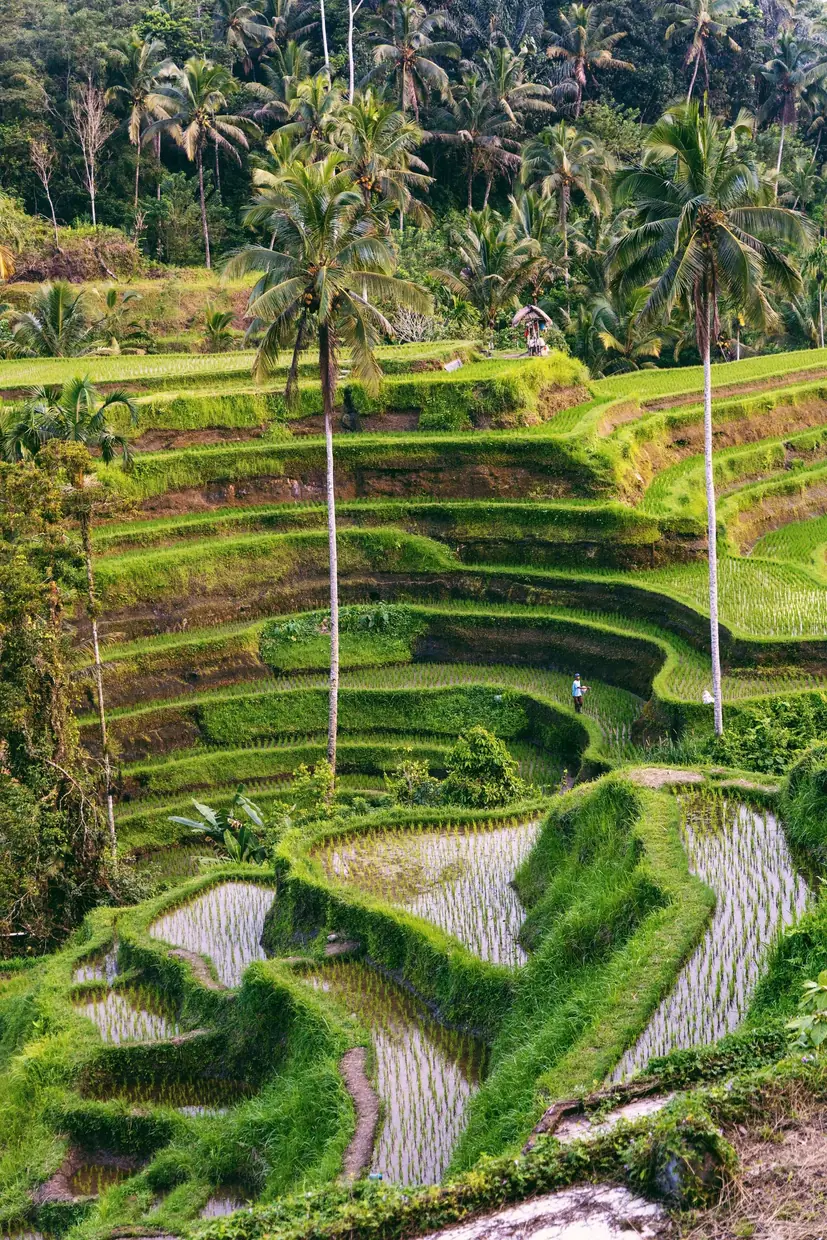
on the documents: green zone — zona/jalur hijau; coastal setback — sempadan pantai; cliff setback — sempadan jurang
Check 3 · Permit
Is there a construction permit?
Every building in Bali must have a construction permit. Since 2021 the former IMB document has been replaced by the building-approval permit — PBG.
A PBG is issued for an approved design through the government's online system, and it confirms that the building complies with the codes and zoning. A building without a valid PBG is illegal: it can be sealed off, fined or ordered demolished at the owner's expense — and it doesn't matter that it already stands and is being rented out. For the buyer there are two different scenarios.
You check that a PBG already exists
And that it is issued for this property and matches what has actually been built: number of storeys, area, designation.
The PBG is already obtained, not "in process"
The project should have its permit in hand before sales start. "In process" is a promise, not a document.
Risk of a freeze and demolition
Building without a permit is a common reason properties on the island are sealed off, fined or demolished.
on the documents: construction permit — PBG (Persetujuan Bangunan Gedung), former name — IMB; online system — SIMBG
Before 2023–2024 there was a widespread practice in Bali: almost all properties were built without obtaining a PBG, and were legalised through an SLF once construction was complete. Properties started in that period without a PBG generally can no longer obtain one retroactively — the procedure is extremely complex and only drags out the project's delivery timeline. That is why the government lets such builds be completed.
What this means for the buyer. For a long-started property without a PBG, the key thing is to confirm that it complies with all the codes and requirements for a PBG and SLF as of the complex's handover and carries no risk of failing to obtain an SLF. If there is no such risk, the property is legally completed and receives its SLF without violations — this practice does exist on the market. But a new build launched without a PBG today is already a red flag.
Check 4 · Occupancy
Can the finished building be legally used?
The permit to build and the right to use are two different documents. Once construction is complete, the building is checked for compliance with the design and safety codes and issued a certificate of fitness for use (SLF). Without it, a finished building cannot formally be commissioned or legally used — and for an investor that means legal renting out and a smooth resale are in question.
In practice the SLF is the final checkbox — the one people often forget to check after focusing on the title and the construction permit. For a new or recently completed property, ask for the SLF just as insistently as the PBG.
on the documents: certificate of fitness for use — SLF (Sertifikat Laik Fungsi)
Who checks
Who checks all this — and why not you yourself?
You can't carry out these checks on your own — and that's normal.
The official land check and the deal itself in Indonesia are handled by the PPAT notary: only they have access to the registry to check the certificate and the right to register the transfer of title. Zoning and permits (PBG/SLF) are checked by the same notary together with an independent lawyer and a technical specialist on the project. The key word is independent: a lawyer and notary on the buyer's side, not "the one the seller recommended."
BDA's role here is to pull this verification into a single system: we coordinate the PPAT notary, lawyers and contractors and check the property before you put down any money. We work with trusted lawyers so that the verification stays independent.
BDA experience
Red flags: when it's better to walk away from a deal?
A few signals from practice at which a deal is worth at least putting on pause.
- A deposit before the checks. The seller demands money before the notary has checked the certificate. The correct order is the opposite.
- A "friendly" contract without a PPAT notary. Any land deal without official registration is legally unprotected.
- A green zone that will "soon be reclassified." A promise to change the land's designation is the seller's risk being shifted onto the buyer.
- A new build launched without a PBG. A property started today without a permit is a red flag (unlike long-started properties, which are allowed to be completed under SLF oversight). Separately, check the risk of failing to obtain an SLF at handover.
- A fence not on the boundary. The actual boundaries don't match the area in the certificate — you inherit the dispute with the neighbours along with the plot.
Checklist
What to check before any money — in one table
Save this: everything you need to keep in mind before buying property in Bali.
| What you check | Where / how | What it confirms | Red flag |
|---|---|---|---|
| Title and owner | land registry (BPN), via the PPAT notary | the seller is the owner, no mortgage or seizure | a certificate "by word of mouth," several heirs |
| Certificate type | the land certificate | the form of ownership is legal for you (leasehold or freehold via PT PMA) | Hak Milik in a foreigner's name, a nominee scheme |
| Zoning | the region's master plan (RTRW / RDTR) | what and how much may be built | green zone, agricultural land |
| Setbacks and height | the zoning plan, Bali codes | the real buildable area, ≤15 m | building within a sea or cliff setback |
| Construction permit | PBG (formerly IMB), the SIMBG system | the building is legal and built to the design | a new build without a PBG; on an old one — non-compliance with PBG/SLF codes |
| Occupancy | the SLF certificate | the building can be legally used | risk of failing to obtain an SLF at handover |
This checklist is indicative and based on BDA's practice and Indonesia's regulations. It is not legal advice; verify any specific deal through a PPAT notary and an independent lawyer.
FAQ
Frequently asked questions
Short answers to what people ask most often about checking a property.
What is due diligence when buying property in Bali?
What is checked in the BPN land registry?
Can you build on any plot in Bali?
How does a PBG differ from the old IMB?
What is an SLF and why does a buyer need it?
Is it risky to buy a property that was built without a PBG?
Who carries out due diligence in Bali?
We'll check the property before you put down any money
BDA supports the purchase and launch of projects in Bali — we coordinate the verification of title, zoning and permits through a PPAT notary and trusted lawyers, before the deposit.
Contact BDA